
- Energy Efficiency
How Queensland Businesses Can Reduce Peak Demand Charges
Understand what drives your demand charges and assess practical ways to reduce them through load management, power factor correction, efficiency, solar and batteries.
A short period of high electricity demand can influence a much larger part of your bill. Understanding when that peak happens—and what causes it—can reveal practical savings without compromising production.
Why peak demand matters
You pay for the electricity you consume, but your tariff may also charge for the capacity you draw from the grid. Running several large loads together can increase that demand, even if your total monthly energy use changes very little.
Reducing the right peak can lower costs, release electrical capacity and help accommodate business growth. The objective is to reduce avoidable demand, with changes that suit your operations.
Energy and demand: what is the difference?
Energy (kWh) is the amount of electricity consumed over time. Demand (kW or kVA) describes the rate at which your installation draws power.
Demand charges commonly use the highest average demand recorded during a defined interval, often 30 minutes, within specified charging windows. They are not necessarily a penalty for exceeding a fixed limit. The measurement period, time windows, minimum billing demand and any capacity or historical-demand rules depend on your tariff and contract.
For example, using 40 kWh over half an hour corresponds to an average demand of 80 kW. A momentary motor-starting spike is different from a sustained half-hour peak. We check the actual billing rules before proposing changes.
How to reduce the peaks
1. Measure before changing anything. Compare your electricity bills, interval data and production schedule. Identify which loads coincide during the chargeable peak. Where existing data is insufficient, temporary monitoring can establish the demand profile and power factor.
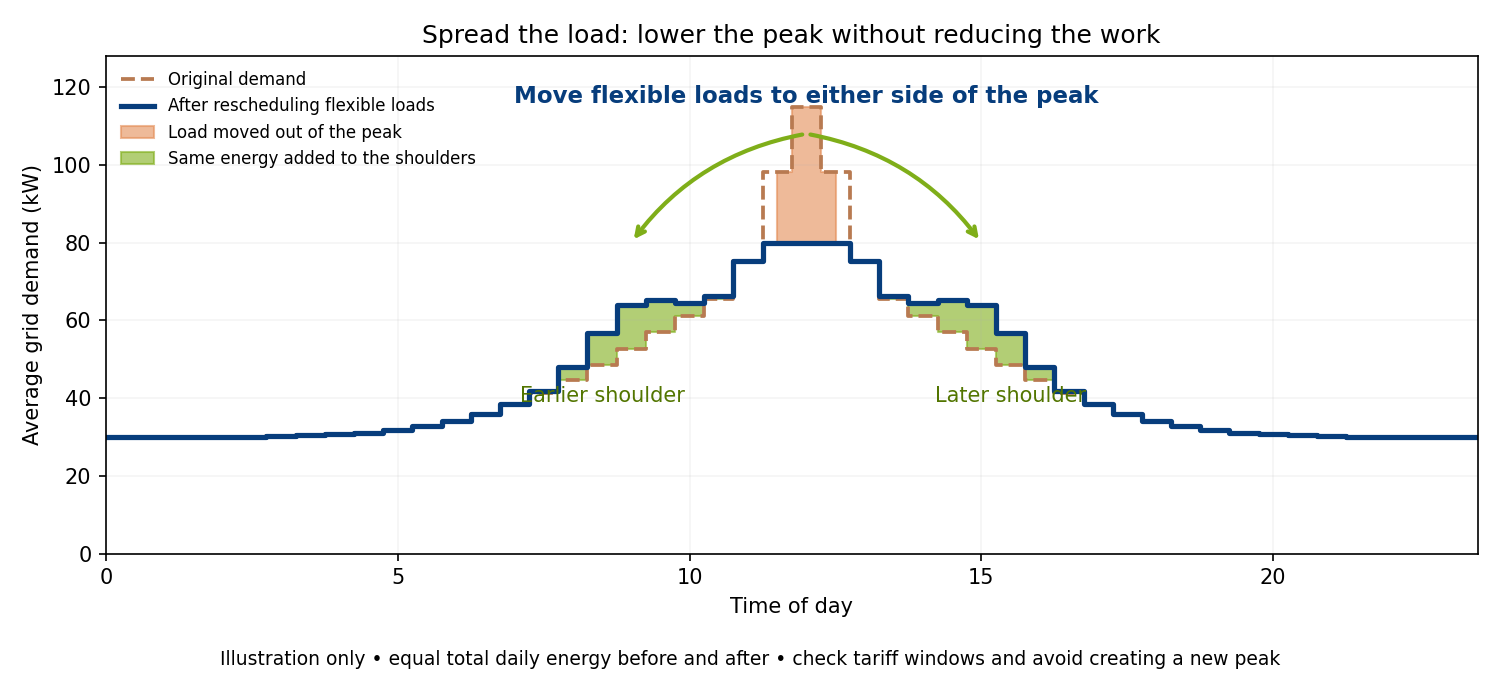
2. Spread flexible loads (load shifting). The shoulders are the lower-demand periods immediately before and after your main peak. Instead of running all large loads together, move flexible tasks into these quieter periods—for example, charge vehicles earlier, run a batch process later or stagger heating and cooling cycles. This spreads the same work and energy over a longer period, flattening the profile. Thermal storage may also help where practical. Moving a load helps only if it reduces the relevant billed peak without creating another one. Safety, product quality and operational requirements come first.
3. Limit grid demand (peak shaving). Controls can temporarily reduce flexible loads, or a battery can supply part of the site demand during a peak. Battery sizing must account for the height, duration and recurrence of the peaks, recharge opportunities, losses and any energy reserved for backup. Explore commercial and industrial batteries.
4. Correct poor power factor. Where demand is charged in kVA, suitable correction can reduce billed apparent demand. For illustration, 100 kW at a power factor of 0.80 is 125 kVA; at 0.95 it is about 105 kVA. The useful 100 kW load is unchanged, while lower current can reduce upstream cable and transformer winding losses.
Capacitor banks suit appropriate lagging-power-factor conditions. They do not correct an already leading power factor and can interact with harmonics. Equipment selection should follow measurement. Read about power quality solutions.
5. Improve efficiency and assess solar. Better process controls and efficient equipment can reduce both kWh consumption and peak demand when they operate during the relevant peak. Solar helps demand charges only when its output coincides with that peak; cloud cover or an evening peak can limit the benefit.
6. Review the tariff. Check available retail and network-tariff arrangements with your retailer. Compare the complete annual bill, including energy, demand, capacity and fixed charges—not just the headline rate.
What could the savings be?
As a simple illustration, reducing billed demand by 20 kVA at an assumed $15 per kVA per month saves $300 for that month, excluding GST. If achieved in all 12 months, that would be $3,600 a year. These are illustrative figures, not a current tariff or savings guarantee. Minimum demand and capacity rules may change the result.
Load shifting and power factor correction can reduce charges without materially reducing the useful energy consumed. An efficiency upgrade can reduce consumption directly. We distinguish those benefits and include equipment, maintenance and finance costs when assessing payback and return on investment.
How Energy Engineers can help
We review your bills, tariff, interval data and operating requirements, then undertake site measurements where needed. We compare operational changes, power factor correction, efficiency upgrades, solar and battery options to identify a practical business case.
You receive a written report and a clear explanation of the findings. Where required, we can prepare an investment-grade assessment with project costs, annual kWh and dollar savings, cash flow, payback, return on investment, assumptions and risks.
We support the project beyond the assessment: engineering design and specifications; equipment-selection advice; independent reviews of designs, proposed equipment and supplier submissions; and advice on the infrastructure changes needed to integrate the solution, including switchboards, cabling, protection, controls and available capacity.
Our client-side engineering project management can include procurement support, supplier and contractor coordination, shutdown planning, installation oversight and commissioning support. We can also undertake follow-up measurements to verify the agreed performance and savings.
Discuss your demand charges with Energy Engineers or call 07 2111 8669. Start with your recent electricity bills and available interval data.
Technical references checked 7 November 2026: Energex network tariffs and current tariff guide; Ergon Energy Retail large-business tariffs. Your retail contract determines how charges appear on your bill.

Share Article:
 Brisbane, AU
 (07) 2111 8669
