
- Energy Efficiency
Heat Pumps for Business: Understanding Efficiency and Savings
Understand heat-pump COP, operating temperatures and whole-system costs before investing, with independent measurements and engineering support.
Heating water or process fluids can be a substantial business cost. A well-selected heat pump can reduce the energy purchased to supply that heat—but the savings depend on the temperatures, operating hours and installation.
Why consider a heat pump?
A heat pump transfers heat from air, water or a suitable waste-heat source into a useful heating demand. Instead of supplying all the heat through an electric element or burning fuel, it uses electricity to move heat that is already available.
This can suit hot water, washing, cleaning and appropriate process-heating duties. Where heating and cooling are both needed, a carefully integrated system can make use of both sides of the heat pump.
How does it work?
In a typical vapour-compression heat pump, refrigerant absorbs heat at the source, a compressor raises its pressure and temperature, and a heat exchanger transfers heat into the water or process. An expansion device lowers the pressure before the cycle repeats.
What does COP actually tell you?
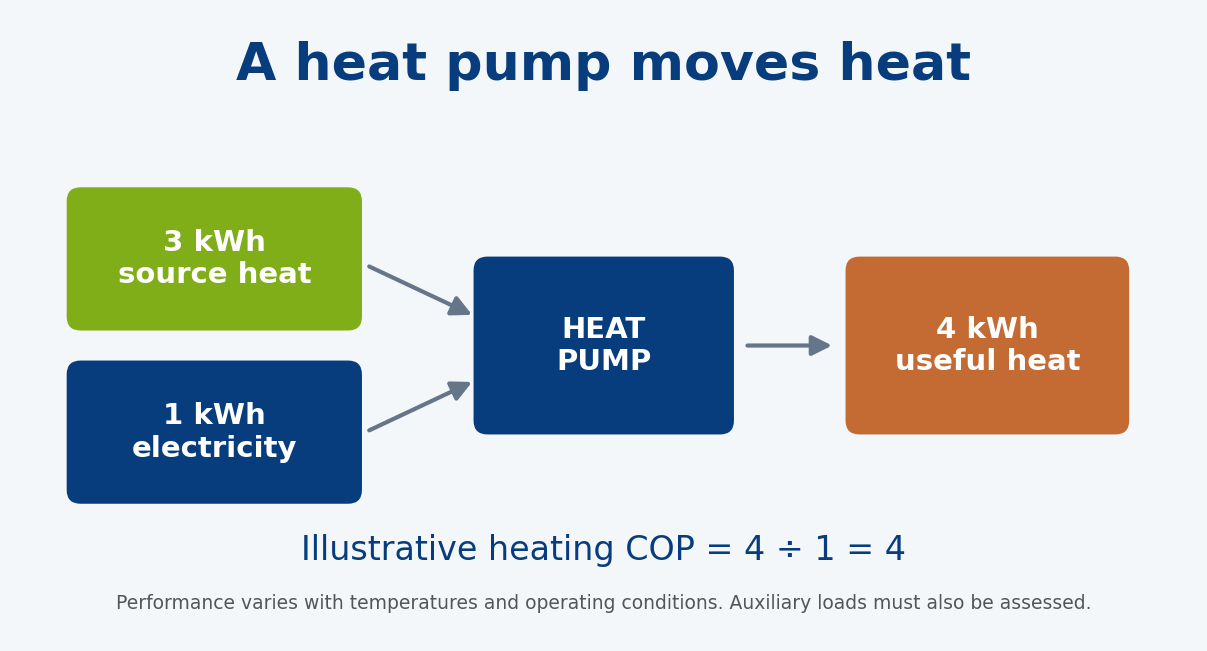
The heating coefficient of performance (COP) is useful heating output divided by electrical input, using the same units. A COP of 4 means 1 kWh of electricity delivers 4 kWh of heat: approximately 3 kWh comes from the source and 1 kWh from the electrical input. The heat pump transfers energy; it does not create energy from nothing.
For comparison, an electric resistance element converts approximately 1 kWh of electricity into 1 kWh of heat at the element. Distribution and storage losses affect both systems.
A quoted COP applies at specified test conditions. Check the source temperature, water inlet and outlet temperatures, part-load operation and what electrical loads are included. Pumps, fans, defrost cycles, standby use and electric boosting can change whole-system performance.
Cooling performance may be described using EER or cooling COP. Check the units and test conditions: EER may be expressed in W/W or, in some overseas literature, Btu/h per watt. Figures using different units or test conditions cannot be compared directly.
What makes an installation efficient?
Keep the temperature lift appropriate. A smaller gap between the heat source and the required delivery temperature generally improves COP. Avoid heating above the temperature genuinely needed, while maintaining hygiene, safety and process requirements.
Match the equipment to the duty. Assess peak heat demand, operating hours, available source heat, recovery time and backup needs. Oversizing, poor flow rates and frequent cycling can undermine performance.
Recover heat that would otherwise be rejected. Refrigeration or process waste heat may be a useful source where its temperature, quantity and timing match the heating demand. Useful simultaneous heating and cooling should be counted with a clearly defined assessment boundary.
Integrate storage and controls. A suitable tank can help smooth demand, reduce cycling and shift operation towards solar generation or cheaper electricity periods. Storage has heat losses, and charging at a higher temperature may reduce COP. Read about energy storage and efficiency.
Will it save money?
Compare the cost of useful heat, not just the price per unit of fuel. As an illustration, electricity at $0.30/kWh and a system COP of 4 gives an electricity cost of $0.075 per kWh of useful heat, before other costs. A fuel-fired system must be compared using its fuel price and delivered efficiency. These are example figures, not a tariff quote or performance guarantee.
The business case also includes capital works, electrical capacity, demand charges, maintenance, storage losses and equipment life. Emissions depend on the displaced fuel, electricity supply and refrigerant impacts; they should be calculated rather than assumed.
We assess annual energy and dollar savings, payback and return on investment, and test how the result changes with electricity prices and operating conditions. Eligible incentives may help, but should be checked against the current funding programs.
How Energy Engineers can help
We provide energy-efficiency audits, electrical infrastructure audits and measurements of energy use, temperatures, flows and operating patterns to establish the baseline and identify suitable options.
An investment-grade report can set out equipment options, expected performance, project costs, annual savings, cash flow, payback, return on investment and key assumptions and risks. We explain the findings so you can make an informed decision.
Our support includes design and specifications, equipment selection, independent review of designs and supplier proposals, and advice on infrastructure changes such as switchboards, cabling, protection, controls and available electrical capacity.
Client-side engineering project management can include procurement support, contractor coordination, shutdown planning, installation oversight and commissioning support, followed by measurements to verify performance.
Discuss your heating or efficiency project or call 07 2111 8669.
Technical references checked 7 November 2026: Australian Government waste-heat recovery guidance; Victorian commercial and industrial heat-pump water-heater guidelines; ARENA renewable industrial process-heat report.

Share Article:

 Brisbane, AU
 (07) 2111 8669
